How to Choose the Right Hotel (And Why It Matters More Than You Think)
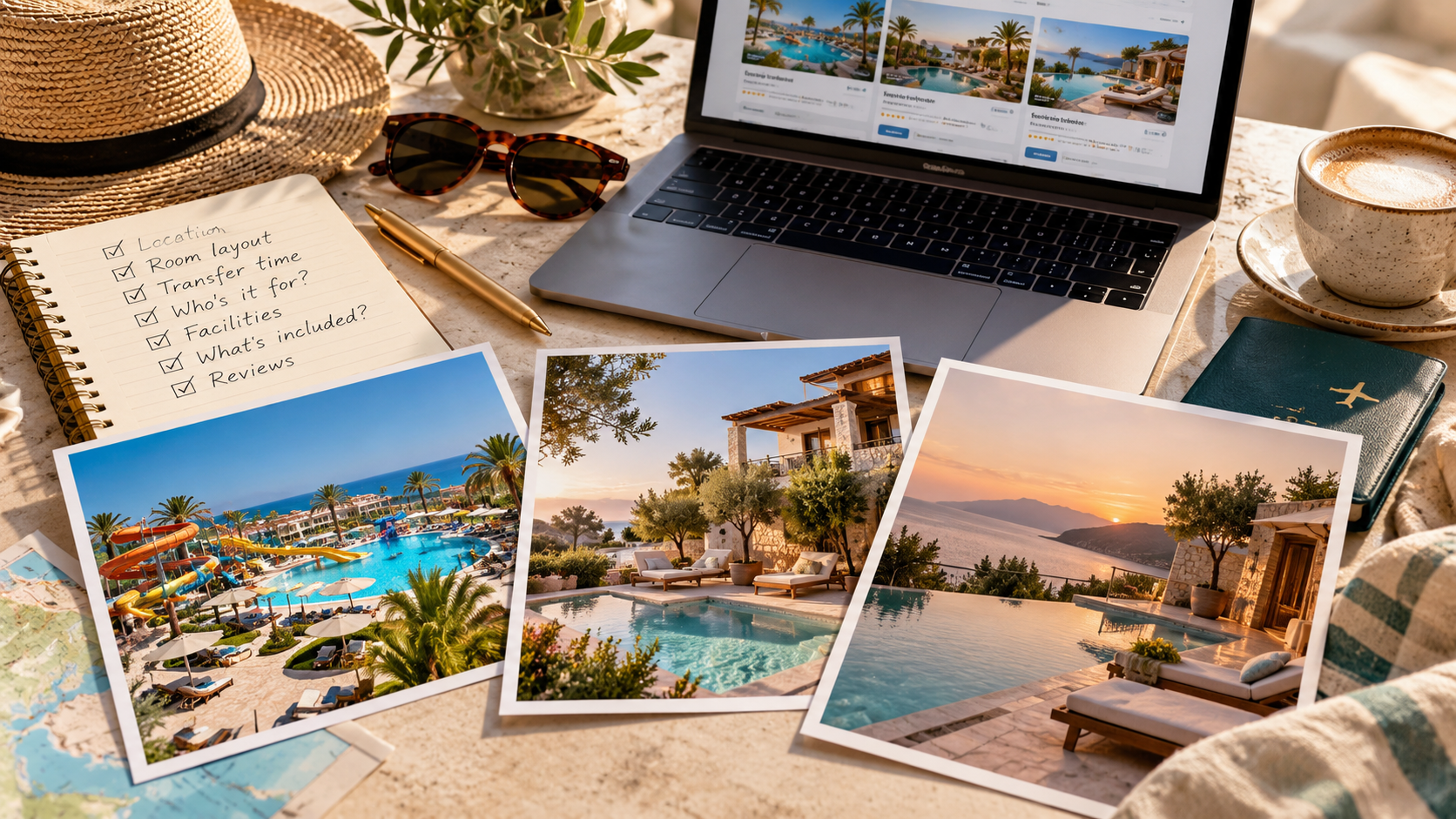
When people think about planning a holiday, the destination usually comes first. The hotel is often treated as a secondary decision - somewhere to sleep between days out.
In reality, I think choosing the right hotel is one of the most important decisions you’ll make.
You can be in your dream destination and still have the wrong holiday because you chose the wrong hotel.
A beautiful adults-focused retreat isn’t much use to a family whose children want waterslides and ice cream on tap. Likewise, the world’s greatest family resort might be somebody else’s idea of absolute hell.
The question isn’t “Is this a good hotel?”
It’s “Is this a good hotel for you?”
A hotel is part of the experience, not a backdrop
The best hotels don’t compete with their surroundings - they complement them. They support the rhythm of a place rather than dominate it.
Whether it’s a small boutique property or a larger resort, the right hotel creates a sense of flow. You feel settled quickly. Nothing jars. Everything feels intentional.
When that alignment is right, the holiday begins the moment you arrive - not once you leave the hotel.
Why star ratings don’t tell the full story
Star ratings are useful, but they’re only part of the picture. They measure facilities and services, not atmosphere or suitability.
Two hotels with the same rating can feel entirely different. One may be calm and refined, the other busy and high-energy. Neither is inherently better - but one will be better for you.
I look beyond the number of stars and ask what those stars actually represent.
What’s included? How are the rooms configured? What’s the pool area like? Where do people spend their evenings? How far is it really from the places you’ll want to visit?
A well-chosen 4-star can give you a far better holiday than a 5-star that doesn’t suit the way you travel.
Location changes everything
A hotel’s setting has a huge impact on how a trip unfolds.
Central locations offer convenience but can bring noise and movement. Quieter settings provide space and stillness, but may require a little more planning.
Neither is right or wrong - it’s about knowing what you want from your days.
Do you imagine wandering out spontaneously for dinner, drinks or a bit of shopping? Or retreating somewhere peaceful at the end of the afternoon and staying there for the evening?
And don’t just look at the distance from the airport.
A transfer described as 45 minutes doesn’t necessarily mean you’ll be sitting beside the pool 45 minutes after collecting your suitcase. Shared transfers can involve waiting for other arrivals and several hotel stops along the way.
Equally, “1 km from the resort centre” sounds insignificant until you’re making that walk twice a day with tired children.
The numbers matter, but so does what those numbers mean in real life.
Design that influences mood
Design isn’t just about aesthetics - it affects how you feel.
Hotels that prioritise natural light, thoughtful layouts and cohesive spaces tend to feel more relaxing. Communal areas invite lingering. Rooms feel like somewhere you want to return to, not just pass through.
When design supports rest, switching off becomes effortless.
And sometimes the smallest design decisions have the biggest impact.
A plug beside the bed. Somewhere sensible to dry your hair. Enough storage to actually unpack. Lighting that works at different times of day.
Beautiful design is lovely.
Beautiful design that actually works is better.
Understanding who the hotel is for
Every good hotel knows its audience.
Some are built for families, others for couples, groups of friends or solo travellers. Problems arise when expectations and reality don’t align.
This is particularly important for families.
“Family-friendly” covers an enormous spectrum.
One family wants kids’ clubs, waterslides, entertainment and snacks available approximately every seventeen minutes.
Another wants a quiet pool, a spacious apartment and somewhere lovely to walk for dinner.
Even the children’s ages matter. What works brilliantly with a five-year-old can feel completely different with a sixteen-year-old.
A hotel that works beautifully for one family may feel completely wrong for another.
Family-friendly isn’t a category. It’s a compatibility question.
Look at the room, not just the hotel
You can choose the perfect resort and still choose the wrong room.
This matters enormously for families and larger groups.
“Sleeps five” tells me how many people the room can technically accommodate. It doesn’t tell me whether five people will actually want to live in it for a fortnight.
Look at the layout.
Proper beds or sofa beds?
Separate sleeping areas or one large room?
How much storage is there?
Is the balcony actually big enough for everyone?
How does the bathroom work when five people are trying to get ready?
And if you’re looking at a swim-up room, who actually has direct access to the pool?
A floor plan can sometimes tell me more than twenty photographs.
Occupancy tells you who fits. Layout tells you whether they’ll be comfortable.
Why fewer choices often lead to better stays
It’s easy to be drawn to hotels that promise everything.
Ten restaurants. Seven pools. A waterpark. Spa. Sports. Entertainment. Kids’ clubs. Beach club. Twenty-three bars and apparently a small civilisation operating within the grounds.
But more isn’t automatically better.
Properties that focus on doing a few things exceptionally well often feel more confident and cohesive. They know what they’re about - and guests benefit from that focus.
Sometimes you genuinely do want the enormous resort where nobody needs to leave for a week.
Sometimes you want one lovely pool, a great breakfast and a town full of restaurants outside the door.
Choose what you’ll actually use, not what makes the longest facilities list.
The quiet impact of a good hotel
The best hotel choices rarely announce themselves.
They’re felt in small moments: a peaceful breakfast, an inviting pool area, a room that feels restorative rather than functional, or being able to walk out after dinner without having to organise transport.
These details accumulate, shaping the overall tone of the trip.
And long after the holiday ends, it’s often the feeling of the hotel - the ease, the atmosphere, the sense of care - that stays with you.
Choosing with intention
Choosing the right hotel isn’t about perfection. It’s about alignment.
It’s about understanding how you actually travel rather than choosing the hotel that looks most impressive on a search results page.
What will your mornings look like?
Will you spend most days exploring or barely leave the resort?
Do your children need constant entertainment or just a pool and decent Wi-Fi?
Do you want nightlife outside the door or absolute silence after dinner?
Are you happy to walk, or will that “short distance to the centre” become irritating by Day Three?
When a hotel supports the kind of holiday you’re hoping to have, everything else falls into place more naturally. The days feel balanced. Rest comes more easily. And the experience feels considered rather than chaotic.
In the end, the right hotel doesn’t just house your holiday - it elevates it.